A First Visit to a Village Green, Taken Slowly
A first visit to a village green becomes more revealing when you notice its edges, paths, nearby buildings, and everyday rhythms without rushing to interpret them.
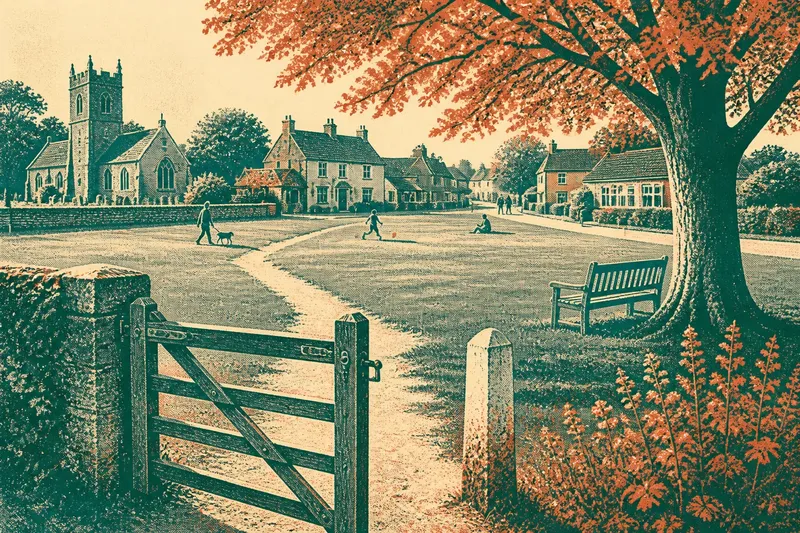
A gate clicks shut behind you, and the village green opens into view: a strip of worn grass, a bench under a tree, and a lane running past its far side. On a first visit to a village green, it is tempting to cross straight through and decide what the place is for. Give yourself time instead. The green is not a still picture but a piece of shared ground, shaped by its boundaries, routes, neighbors, and changing uses.
A careful visit does not require a notebook full of facts or a theory about village life. It asks for attention in a useful order. Start with the ground you can see, then notice how people and buildings meet it. Keep your conclusions modest: a quiet afternoon can show you what is happening now, not the whole story of the place.
Begin at the edge
Pause just before entering, where you can take in the whole green without standing in the middle of someone’s route. Look for the point where public ground begins. It may be marked by a low curb, a row of posts, a change in grass, a ditch, a footpath sign, or no obvious boundary at all. The edge can be clear in one direction and uncertain in another.
Notice what the green touches. A churchyard, a pub garden, a house front, a stream, a school, or a car park gives the open space a different set of neighbors. A hedge can screen activity; a low wall can offer a place to sit; a broad opening can make a footpath feel like part of the village’s everyday circulation. These are visible relationships, not proof of a single intended purpose.
Look for signs of care as well as signs of wear. A mown strip beside longer grass may suggest that the space is managed in more than one way. A cleared drain, a repaired gate, or a neatly stacked pile of branches may show practical attention. Avoid treating every patch of mud as neglect or every flower bed as a formal plan. Maintenance can be seasonal, shared, or difficult to read from a passing glance.
Read the routes
Next, follow the paths with your eyes before choosing one with your feet. Some routes are formal, surfaced, and direct. Others are faint tracks pressed into the grass, cutting between a gate and a shop or linking two lanes. Their directions can tell you which crossings people favor, though one visible track cannot explain who made it or when.
Watch where paths narrow, divide, or meet a threshold. A path that skirts a bench may leave room for sitting without interrupting walkers. A track that cuts a corner might connect the shortest route between two destinations. If you take a route across the green, keep to the path where one is provided and leave space for people using the place in other ways.
Listen as well as look. Footsteps on gravel, a gate latch, traffic from the lane, or conversation near a doorway can reveal how the green connects to its surroundings. The sound may change as you move: a hedge can soften road noise, while an open side can carry the clatter of a delivery van. These shifts help you understand the green as part of a lived landscape, not a quiet island set apart from the village.
Notice the neighbors
Turn toward the buildings around the green and attend to their relationship with the open space. A front door facing the grass offers a different outlook from a blank gable or a tall hedge. Windows, gates, porches, and garden boundaries can make the green feel observed, enclosed, welcoming, or simply adjacent. Resist assigning motives to residents; describe what the arrangement lets you see.
Look at how the ground meets each building. A paved threshold may connect a doorway to a path, while a step, low wall, or planted border separates private space from the common ground. A pub sign or shop window can suggest a destination, but it does not tell you whether visitors are welcome inside or whether the business is open. If you want to enter, follow posted signs and ordinary local etiquette.
Imagine you arrive on a mild afternoon and see a narrow path between the green and a village hall, with a bench facing away from the road. You could note that the path links the hall to the open space and that the bench offers a view across the grass. You might expect to see walkers use the route and someone pause on the bench, but that remains a possibility, not a report of what happens every day.
Watch use without intruding
Give the green a quiet interval of attention. You might see someone crossing with a dog, a child following a ball, a person sitting alone, or nobody at all. The important detail is not to turn passersby into characters in a story. Notice movement, spacing, and the way the place accommodates—or fails to accommodate—different activities.
See whether people follow the paths or move across the grass. Notice if a bench faces a view, a road, or another seat. Watch how gates and signs guide movement, and whether people pause near a particular edge. Keep a respectful distance from private gardens and do not photograph individuals without permission. The aim is to understand the arrangement of the place, not to collect private details about its users.
A single visit captures a particular combination of weather, light, season, and time of day. A wet morning may leave the grass empty; a sunny afternoon may bring children and walkers. A village green can also be used differently during a local gathering, a school day, or a quiet evening. Record the conditions you can see so that you do not mistake a moment for a permanent pattern.
Questions a first visit raises?
How long should I spend at a village green?
There is no fixed length of time that makes a visit complete. Allow enough time to observe the edges, take in the routes, and sit or stand without blocking anyone’s way.
Should I walk across the grass?
Use a marked path where one exists, and notice whether the grass shows a customary route. If the space is clearly open and no signs discourage crossing, move considerately and avoid disturbing planted or worn areas.
What should I bring?
A small notebook and a pencil can help you record details without relying on photographs. A simple map or an offline map app can help you understand how the green meets nearby lanes, but observation matters more than equipment.
Can one visit explain the green’s history?
No single visit can establish how the green began or how its use has changed. It can give you questions to carry into another visit, such as whether a path appears in different seasons or whether a nearby building has a public role.
Leave room for return
Before leaving, look back from the edge you entered. The view may have shifted as people moved, clouds passed, or you began to notice a route you missed at first. You do not need to settle on a final interpretation. A few grounded notes—where paths meet, which buildings face the grass, what signs are present, and what the space was like during your visit—are enough to make a later comparison meaningful.
If you return, choose a different time or approach from another lane. Notice what has changed and what remains visible: a gate may be open, a bench occupied, or a path softened by rain. The first visit to a village green is most useful when it leaves you alert to those differences, and careful not to mistake one quiet afternoon for the life of the place in full.