The Local Dish That Never Had One Fixed Recipe
A local dish with no fixed recipe makes more sense when you read its ingredients, household preferences, and occasion before choosing a version to cook.
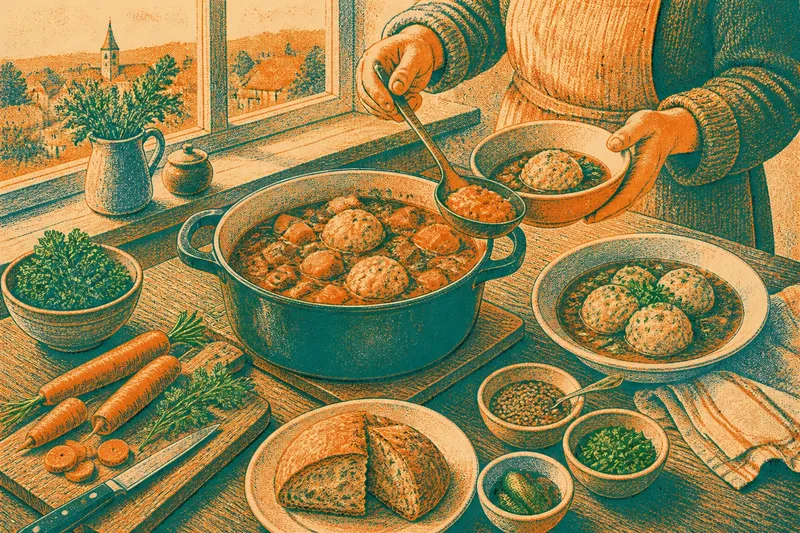
At a kitchen table in eastern England, one bowl of dumplings may arrive beside a thick stew, while another household serves them lighter, with herbs folded through the dough. The local dish has no single fixed recipe; its character comes from what a household has, likes, and needs that day.
That can unsettle a cook looking for the authoritative version. But the useful question is not which recipe wins. It is which version fits the ingredients and occasion in front of you. Treat the dish as a set of choices, and regional variation becomes easier to understand—and easier to cook without pretending that every home follows the same rules.
Begin with the dish
Many regional foods are recognized by their structure rather than by an exact ingredient list. A savory pie might be understood through its pastry, filling, and role as a portable meal. A stew might depend on a pot of slowly cooked ingredients served with bread or dumplings. Within that frame, families make different choices.
Those choices can reflect what is close at hand: garden produce, stored roots, a butcher’s cuts, or ingredients brought home from a local shop. They can also reflect taste and habit. One cook may favor a loose broth; another may reduce it until it clings to the spoon. Both can make a dish that neighbors recognize.
When you encounter a local recipe, look for the parts that recur across versions. Ask what gives the dish its name, what makes it filling, and how it is usually served. Those clues help separate its recognizable shape from details that a particular household may change.
Choose by your situation
Use the version that suits the circumstances, rather than trying to reproduce a supposedly final form. A few practical situations point toward different decisions.
- If you are cooking from a family recipe: Keep its defining ingredient or preparation intact, then adjust only where the instructions allow room. The recipe’s value may lie as much in its remembered taste and serving custom as in its ingredient list.
- If your pantry is sparse: Preserve the dish’s basic structure and use a suitable available substitute for a secondary ingredient. A root vegetable can take the place of another root vegetable in a stew, for example, while the seasoning and cooking method remain familiar.
- If you are cooking for a shared table: Choose the milder, more adaptable version, and offer sharper additions—mustard, chopped herbs, or pickles—on the side. That lets guests season their own portions without splitting the main pot into competing versions.
- If you are serving it as a substantial meal: Favor a fuller mixture or an accompaniment such as bread, potatoes, or dumplings. If the dish is one course among several, a lighter preparation may be more fitting.
- If you are trying a regional dish for the first time: Start with a version from a local cookbook or a cook who knows the food, then note which elements seem central and which are presented as options. That gives you a useful reference without turning one recipe into a rule for every household.
Imagine you have a family recipe for a vegetable stew, but the market has no parsnips and you are serving it alongside other dishes. You could use carrots and keep the broth relatively light, rather than adding extra dumplings to make the stew a full meal. The expected result is a bowl that still fits the recipe’s general character while making sense for the ingredients and the table.
Read the occasion
Food changes with the work a meal has to do. A dish prepared for a busy weekday may use ingredients that cook together in one pot. For a gathering, the same household might spend more time shaping pastry, adding a garnish, or making a richer filling. The occasion influences both effort and presentation.
Season matters, too, but not as a tidy calendar rule. A cook may use fresh greens when they are readily available, then rely on stored vegetables or preserved ingredients later. In an eastern regional kitchen, coast, market town, and inland village can offer different possibilities even within the same broad area. A recipe’s local identity does not require every ingredient to come from one place.
Think about who is eating and how the food will be served. A dish meant to travel to a neighbor’s house needs to hold together and reheat well. One served straight from the stove can be looser and more delicate. These are not merely practical compromises; they help explain why a food can have several settled household forms.
Keep the anchors
When adapting a recipe, change one meaningful element at a time. If you replace a vegetable, keep the seasoning and method close to the version you know. If you change the texture, leave the main ingredients alone. This makes it easier to see whether the result still tastes like the dish you intended to make.
Some elements are more central than others. They might include a particular dough, a distinctive seasoning, or the way ingredients are layered and cooked. Other details—such as which of two similar vegetables goes into the pot—may be flexible. Recipes often signal this through phrases like “if available,” “to taste,” or “or another seasonal vegetable.”
Where the right choice depends on a product label, manufacturer instructions, or local rules, follow those directions rather than improvising. For ordinary substitutions, use common sense about flavor, texture, and the needs of the people at your table.
Questions cooks ask?
Does a local dish need one official recipe?
Not necessarily. A dish can remain recognizable through its form, role, and characteristic ingredients while households adapt smaller details. A printed recipe is a useful account of one version, not automatic proof that every other version is wrong.
How do I know what I can substitute?
Consider what the ingredient contributes: sweetness, firmness, moisture, richness, or aroma. Choose a replacement that serves a similar purpose, and keep other parts steady so the dish does not shift in several directions at once.
Should I change a recipe for guests?
Yes, where the adjustment respects the dish and the people eating it. A milder base with optional seasonings at the table can accommodate different preferences without making the central preparation feel anonymous.
How should I describe my version?
Name the household, place, or source when you know it, and call it a version rather than the definitive form. That small distinction gives credit to a particular way of cooking while leaving space for its neighbors.
Let variation speak
A regional dish is often best understood as a conversation between familiar form and everyday choice. The recipe may travel from a village kitchen to a town table, but each cook meets a different market, appetite, and occasion. Naming those differences does not weaken the dish’s identity; it makes that identity more precise.
So when you search for a local dish with no fixed recipe, look for the recurring anchors, then choose the version that suits your own table. Keep a note of the source and the changes you made. Over time, that note becomes a clear record of your household’s version—not a claim to the only authentic one.