The Market Hall Before the Supermarket
The market hall shows how a covered civic building brought sellers and neighbors together, and what to notice in its entrances, stalls, and daily rhythms.
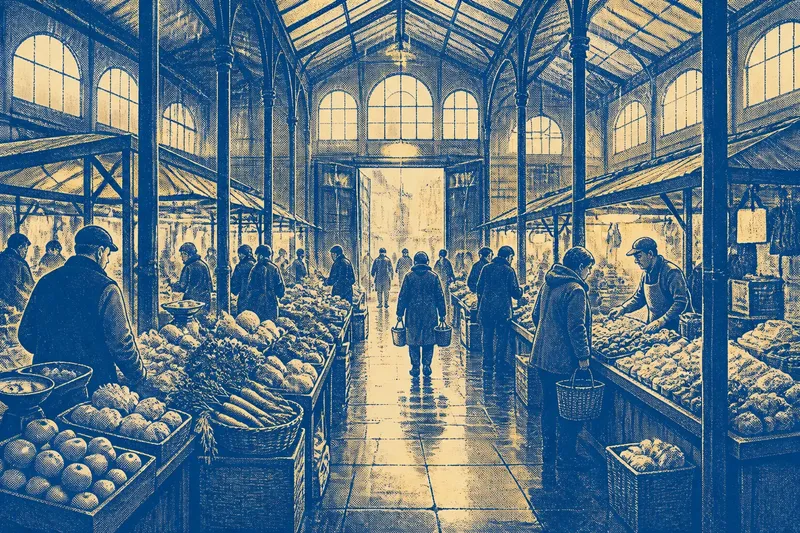
On a wet morning, a market hall changes the sound of a town. Rain ticks against the roof while shoes cross stone or tile, stallholders lift shutters, and a door opens onto the street. The market hall before the supermarket was more than a place to buy provisions: its covered form gathered trade and ordinary public life under one roof.
To understand that role, spend a day reading the building in sequence. Arrive before the busiest trade, return when the hall is full, then look again as stalls close. The same room can work as shelter, workplace, meeting place, and route through the town, depending on the hour.
A morning at the doors
Begin outside, before entering. Notice where the doors face. A hall set beside a main street may invite passersby directly in; one placed near a square can turn its entrance into part of a larger civic space. Look for more than the grandest doorway. Side entrances, service doors, and open arches often reveal how people and goods were expected to move.
Then walk the perimeter. A covered market needs a way to bring in produce, baskets, crates, and equipment without making every customer pass through the same narrow opening. Look for broad thresholds, secondary gates, or a lane that reaches the back of the building. These practical arrangements can be as revealing as a decorative facade.
Inside, pause before choosing a route. A central aisle can make browsing feel like a public promenade. Rows of stalls may instead divide the room into smaller working territories, each with its own customers and routines. In either arrangement, the roof makes the whole space legible as one place, even when individual sellers keep distinct counters and displays.
Notice the floor, too. Stone, tile, or worn paving marks the paths of feet and handcarts. A slight difference in surface near an entrance may reflect the way a threshold meets the street. Do not infer a building's original purpose from a single surviving detail; repairs and later uses often leave their own traces.
When trade gathers
Return when business is underway. The hall's public character becomes clearer in the small exchanges: a customer pauses to compare goods, a seller calls to someone arriving, or two neighbors stop talking without leaving the aisle. These moments are not separate from commerce. They are part of how a regular market becomes a familiar meeting place.
The covered interior makes these encounters possible without requiring everyone to have the same reason for coming. One person may be buying food; another may be accompanying a relative or crossing the hall on the way elsewhere. Weather matters, but so does the shared arrangement: stalls face into space that no single seller controls.
Consider how sound travels. A high roof can carry voices across the room, while columns or stall partitions break up sightlines. The result is neither a private shop nor an open street. People remain aware of one another, yet each exchange takes place at a counter or within a stall's working area.
Say you enter an unfamiliar hall on a damp weekday morning. You come to buy apples, but the stall you want is still being set up. While waiting, you notice a wide central aisle, a side door opening onto a lane, and several people greeting one another near the entrance. Those observations suggest how the building supports both movement and lingering; they do not require you to know its entire history.
Reading the shared room
Look up after the aisles grow busier. Roof structure is not just a visual flourish. It spans a space large enough to hold trade, helps keep weather off goods and visitors, and gives many separate stalls a common interior. Depending on the hall, the roof may rest on masonry walls, columns, or a frame that leaves the trading floor open.
Light shapes the room as much as enclosure does. Windows high on a wall, roof openings, or glazed sections may bring daylight to the stalls without turning the market into a fully exposed outdoor space. Watch how the light falls across counters and walkways. The arrangement can make some corners feel bright and busy while others stay quieter.
Also look for the boundary between public and working space. A stall counter lets a seller display goods and serve customers while keeping storage, tools, or preparation behind it. The building holds these different activities close together, but not in exactly the same space. That distinction is one reason a hall can feel communal without becoming an undifferentiated room.
As the hall closes
Return near closing time. Goods disappear from displays, surfaces are cleared, and customers thin out. The hall may seem suddenly larger, but the change exposes its working infrastructure: storage doors, wash areas, service passages, and places where stall equipment is kept. Not every building retains these features, and later alterations may have changed the original arrangement.
Notice which doors remain active as public entrances and which seem intended for deliveries or staff. A hall's daily life depends on both. Customers encounter the welcoming face of the building; the less visible routes allow sellers to prepare, restock, and clear away. These paths can explain why the building occupies a particular position among nearby streets and shops.
As you leave, take one last look at the approach from outside. The hall may sit beside other shops, open onto a square, or stand apart as a distinct civic building. Its relationship with the street matters: a market hall is not simply a roof placed over stalls, but a public room connected to the town's everyday paths.
Questions about market halls?
Why did market halls need a roof?
A roof sheltered sellers, goods, and customers while allowing trade to continue in unsettled weather. It also gathered separate stalls into a recognizable shared interior.
How is a market hall different from a shop?
A shop is generally organized around one business, while a market hall brings multiple sellers into a common building. Its aisles and entrances serve the public collectively, even as each stall has its own counter and routines.
What should visitors notice first?
Start with entrances, aisles, and the way the roof spans the trading floor. Then watch how people move between stalls and whether the building connects directly to a street, square, or service lane.
Do market halls still serve a public role?
Some remain active markets, while others have changed use or combine trade with other activities. In either case, their entrances, shared interior, and relationship to surrounding streets can still show how the building once joined commerce with public life.
A building in daily use
The market hall before the supermarket is easiest to understand as a building encountered at different hours, not as a fixed architectural object. Its doors admit the town, its roof shelters a common room, and its stalls give individual sellers a place within it. When you visit one, follow the change from quiet opening to crowded trade to closing work. The rhythm makes visible what the plan alone cannot: a public building is shaped not only by what it encloses, but by the repeated ways people enter, meet, buy, and pass through.