Brick, Stone or Timber: Reading a Street by Its Materials
Brick, stone or timber street reading helps you notice color, texture and repair, and choose what a building’s visible surface can—and cannot—tell you.
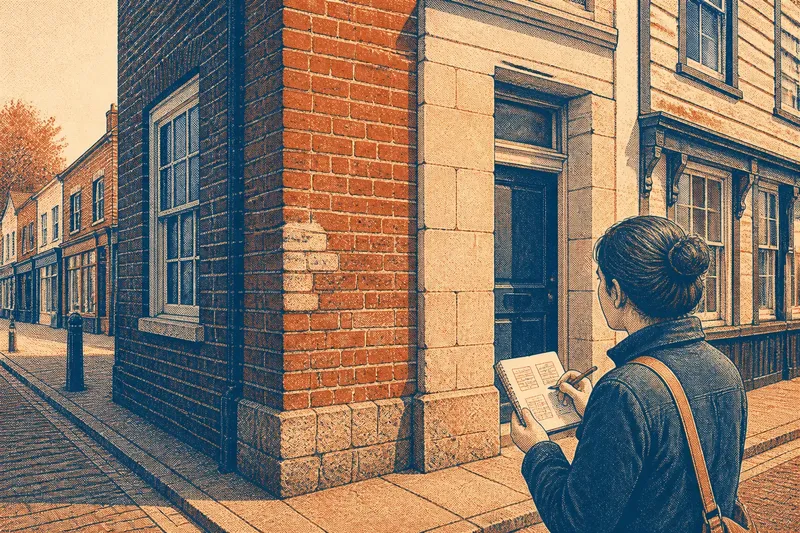
At the corner, a red brick wall turns from sun into shade, while a pale stone doorway catches the last light. Brick, stone or timber street reading begins with such small changes: color, texture and repair. These surfaces offer clues about how a street looks and is kept, but they do not provide a complete account of its history.
Start with the surface
Choose a short stretch of street and look from the public path. Notice which materials repeat, where they meet, and how their appearance changes across a facade. A phone camera can help you compare details later; a pocket notebook is useful for recording what you actually see rather than what you assume.
Keep observation and interpretation separate. “Dark bricks around a window” is an observation. “The opening was added later” is an interpretation that may need more evidence. A building can be altered, reclad or repaired in ways that are not apparent from the sidewalk.
Color is a useful starting point, though light alters it. Brick may read as russet in sun and brown in shadow. Stone can look warm or cool depending on the neighboring materials. Timber may show paint, weathering or exposed grain. Compare surfaces under similar light before treating a difference as a meaningful pattern.
Brick and its patterns
Brick offers a close, repetitive texture. Look at the joints as well as the units: mortar color, width and condition can change the rhythm of a wall. Bond patterns—such as rows with alternating short ends and long faces—are visible features, not reliable labels for a building’s age or purpose.
Repairs often stand out as patches that differ in color, texture or mortar. A neat patch may be recent, or it may simply have weathered differently from the surrounding wall. A replacement brick can also be chosen to blend in. Treat these differences as evidence of maintenance, not as a timeline.
Brick suits close looking on streets where repeated facades make subtle changes easy to compare. It can also be difficult to read when paint covers the surface, or when a thin brick facing hides what lies behind it. What you see is the visible finish, not necessarily the whole wall.
Stone and its edges
Stone often draws attention through variation: a rough face beside a smooth sill, or blocks whose color shifts across the same wall. Look for changes in finish at corners, around windows and near entrances. These details describe how the surface is arranged; they do not, on their own, identify the quarry, builder or period.
Weathering may leave softened edges, dark streaks or a roughened patch. Water runoff, shade, dirt and repair can all affect the appearance. A clean replacement block may contrast sharply with older-looking stone without explaining when or why it was installed.
Stone is a rewarding choice for observing edges and transitions, especially where doorways and window surrounds use a different finish from the main wall. It can be less legible from a distance, where pale surfaces flatten into one tone. Move your attention between the overall facade and a detail you can see from the public way.
Timber and its layers
Timber makes change visible through grain, joints, paint and weathering. Boards may run vertically or horizontally; exposed ends and trim can create a distinct outline around openings. Painted wood conceals some of that texture, but peeling or worn areas may reveal layers of color rather than a simple record of the building’s past.
Repairs can appear as a board with a different grain, a fresh coat that stops at a corner, or a replaced section with a slightly different profile. Sun and rain affect different faces unevenly, so one side of a building may look more worn than another. Avoid reading that contrast as proof of neglect or age.
Timber suits a street where painted details and visible joinery reward close attention. It can be harder to compare when most surfaces are coated or covered by later cladding. In that case, note the trim and openings that remain visible rather than guessing at hidden construction.
Which clues help most?
What can color tell me?
Color helps you compare neighboring surfaces, patches and finishes. It cannot reliably identify a material’s source or the date of a repair, since light, paint and weather all change appearance.
How should I read a repair?
Describe its location, shape and contrast with the surrounding surface. A repair signals care or alteration, but its appearance alone rarely tells you who made it or when.
Can I identify a building’s age from its materials?
Not confidently from a street view alone. Materials may be reused, covered or replaced, so treat age as an open question unless you have reliable supporting information.
Which material should I focus on?
Choose the one with the clearest visible details on the street you are walking. Brick favors repeated pattern, stone invites attention to edges, and timber makes finishes and weathering easy to notice.
Choose a reading method
There are three useful approaches, and each suits a different kind of walk. Pick one rather than trying to decode every facade at once.
- Compare color: Useful on a row where similar surfaces sit in different light. Note the shade and conditions before interpreting a contrast.
- Follow texture: Useful where brick bonds, stone finishes or timber grain remain exposed. Look for repetition and interruptions.
- Track repairs: Useful when patched areas are clearly visible. Record where they occur and how they differ, without assigning a date or cause.
Say you are walking a short block with brick storefronts, a stone entrance and painted timber trim. You note that one brick patch is paler, the entrance has a rough lower course, and the trim’s paint is worn on the sunny side. The expected result is a more precise account of the street’s visible materials and upkeep—not a settled story about its builders.
When a surface’s treatment or local protection rules matter, follow the relevant label, manufacturer instructions or local guidance; do not infer permission to alter it from appearance alone.
Keep the limits visible
A useful street note is modest: “pale mortar around a repaired opening,” or “timber boards with uneven paint.” Such descriptions let another observer see what caught your attention without asking them to accept a theory. They also make brick, stone or timber street reading more attentive, since uncertainty becomes part of the observation rather than a gap to fill.
On your next walk, choose one material and watch how it meets its neighbors. The junction between brick and stone, or painted timber and masonry, often gives you more to notice than a guess about the building’s full past.